

How stainless steel furniture is made at Acier Studio
Stainless steel furniture performs because of what happens before you ever see it; the alloy choice, the way it is cut, formed, welded, cleaned, and finished governs how a shelf resists fingerprints, how a table resists corrosion, and how every corner reads in a quiet interior.
Material fundamentals that shape the process
Most furniture-grade stainless at Acier Studio is 304 or 316 austenitic steel. Both rely on a thin, chromium‑rich oxide that forms spontaneously in air; this passive film is what keeps the metal stainless. That same chemistry imposes discipline on fabrication.
- Austenitic stainless work‑hardens under cutting and forming, which raises forces and heat
- It springs back more than mild steel when bent; operators must compensate on the press brake
- Surface iron contamination defeats passivity; tools, benches, and abrasives are kept stainless‑only
- Post‑weld heat tint is a chromium‑depleted oxide that must be removed to restore corrosion resistance
These are not workshop myths. The Nickel Institute’s Practical Guidelines for the Fabrication of Austenitic Stainless Steels documents passivity, work‑hardening, and contamination control in depth (Nickel Institute).
From flat sheet to form: cutting and bending
Shelves, table tops, and leg components begin as flat sheet. For tight tolerances and clean edges, we specify laser or waterjet cutting depending on thickness and edge requirement. Laser is efficient and precise on thin to medium gauges; waterjet avoids heat‑affected zones on thicker parts or where a cold edge is preferred. Xometry’s process guidance aligns with this choice, noting laser and waterjet as the dominant methods for stainless with fine feature control.
Forming gives the metal its stiffness. On the press brake, stainless’ higher yield strength and springback mean more tonnage and different bend allowances than mild steel. We calculate bend deductions to maintain dimensional accuracy, then validate with test coupons, watching the neutral axis shift. Tooling is clean and reserved for stainless; even a trace of carbon steel can seed rust later. Operators set backstops to keep grain direction consistent through a part family so that final brushing reads as one surface.
TIG welding to post‑weld integrity
Thin visible joins are TIG welded for control. The torch, filler, and pulse settings are tuned to keep heat low; that limits distortion on long shelves and keeps tables flat. Good fit‑up reduces the need for filler and results in finer beads. For closed forms, argon purging on the root side prevents sugaring. Clamps and copper backing bars help draw heat away and support the bead.
Every TIG weld on stainless raises oxide colors as the metal heats; those blues and straws are not cosmetic, they mark chromium depletion. We remove the tint mechanically by dressing to profile with progressively finer abrasives, always aligning with the final grain, and then restore full corrosion resistance chemically. Depending on the geometry, we use pickling and passivation gels followed by thorough rinsing, or a dedicated nitric‑based passivation bath for small components. Electropolishing is reserved for interiors that demand a very low roughness and a reflective, ultra‑clean surface; it levels the microscopic peaks and enriches the chromium at the surface. These steps return the metal to a state where a uniform, self‑healing passive film can form in service, as described by the Nickel Institute’s guidance.
Finish control in the grain
Most Acier Studio pieces are specified in a directional brushed finish because it suits architectural interiors and hides everyday handling. Achieving an even brush is a matter of grit progression and discipline. After fabrication we establish a base grain, then blend welds until the scratch pattern is continuous across joins. We finish with controlled belts and nonwoven pads in a single direction along the length of the piece. The practice mirrors industry standards for No.‑4 type brushing; consistency of grit and grain direction is what makes seams disappear, as outlined by MW Metal Fab’s explanation of graining and brushed finishes.
Reflectivity is a design tool as much as a surface property. Brushed steel reads quieter than a mirror polish in living spaces. In compact rooms or under low ceilings, highly reflective planes can multiply visual “noise”; a satin brush is calmer, and it pairs well with wood and honed stone. Soft textiles temper the coolness without fighting the metal’s character.
In the Aarhus workshop: the Bergen steel shelf
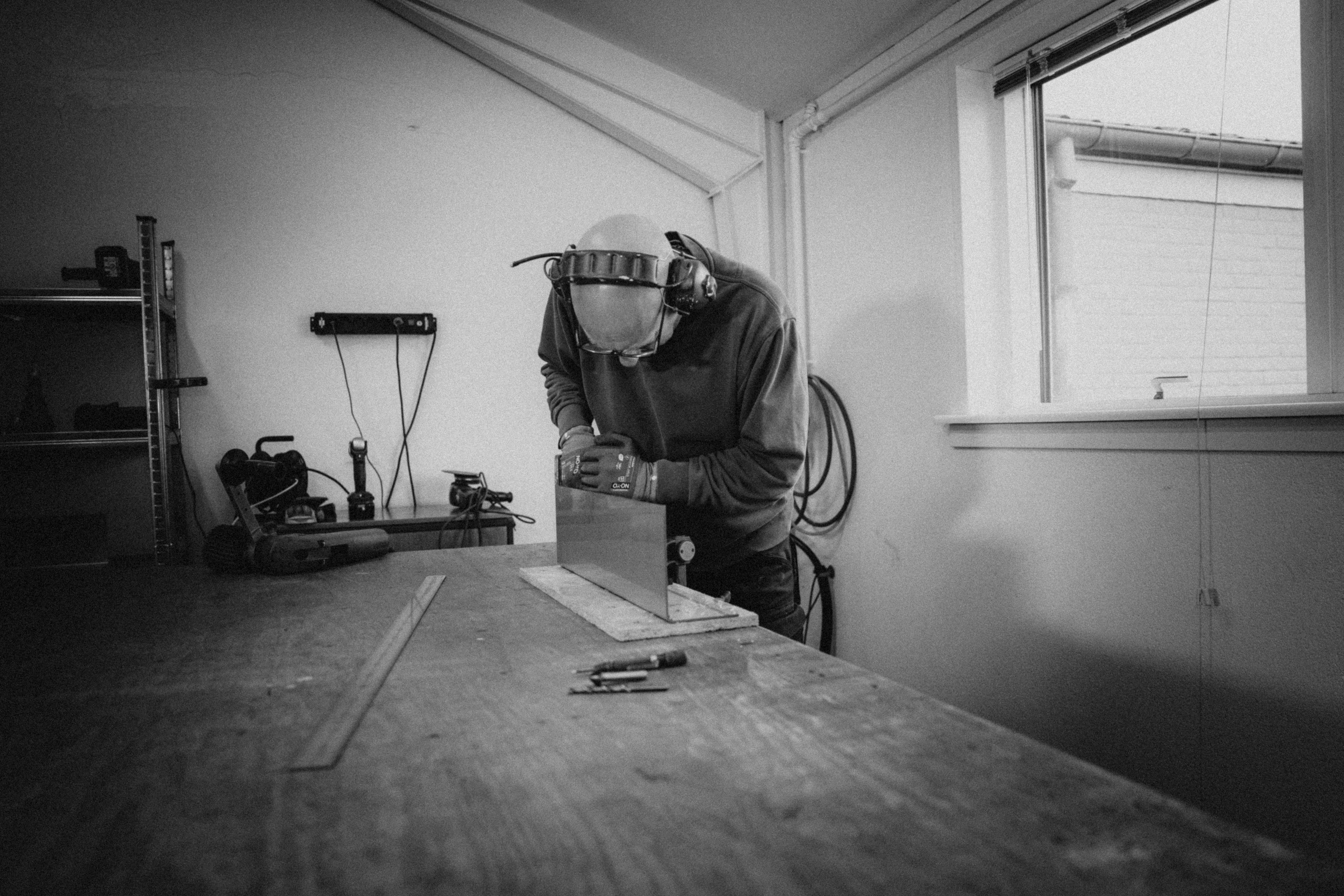
A typical Acier Studio shelf begins as a single sheet folded into a stiff U‑section; the return on the front edge adds rigidity without bulk. Corners are TIG welded, then blended so the light travels smoothly around the edge. The grain runs uninterrupted along the span, and exposed edges are eased to a comfortable touch. Mounting slots on the back web accept concealed hardware so the form reads as a floating line on the wall.
This is the logic behind the Bergen steel shelf; a compact, architectural element where proportion, grain direction, and edge detail do the visual work. You can see how that thinking resolves in the finished piece here: Bergen steel shelf product page.
The choice to fabricate this way in Aarhus is cultural as much as technical. Danish workshops have long valued small‑batch precision, intentional decisions about whether to express or conceal a weld, and the freedom to tune proportion at the part level. The Designmuseum Danmark documents this lineage of studio‑scale metalwork and its emphasis on material literacy rather than line‑speed. The result is tighter control of surfaces and joins than automated lines typically allow.
Care and maintenance in use
Stainless is forgiving, but it benefits from the same thoughtfulness it receives in the workshop.
- Wipe daily fingerprints with warm water and a drop of pH‑neutral dish soap; dry with a microfiber cloth along the grain
- Avoid bleach and high‑chloride cleaners; chlorides undercut passivity, especially at welds and edges
- For scuffs, use a fine nonwoven pad in the direction of the grain, working lightly and finishing with a clean cloth; do not use steel wool, which deposits iron
- If you see tea‑staining outdoors or in coastal interiors, clean with a mild citric‑based stainless cleaner, rinse, and dry; the chromium‑rich film will re‑form in air
- Under acidic foods or cleaners, use coasters and wipe spills promptly; acids can etch any finish if left to dry
Over years of use, occasional re‑brushing can renew uniformity. For severe discoloration near a weld, a passivation gel used exactly as directed can help restore the surface; rinse thoroughly. Placement also matters over time. Highly reflective finishes amplify clutter in compact rooms; a consistent brushed finish stays visually calm and pairs well with natural textures, a point echoed in Homestyler’s guidance on balancing cool metals with wood, stone, and textiles.
A stainless steel table or shelf made this way accrues value rather than wear. The grain can be refreshed, the passive film self‑heals when cared for, and the geometry does not date. Danish workshop methods prioritise repairability and surface control; that investment of time and judgment is legible decades later in edges that still read crisp, planes that remain true, and a finish that continues to sit quietly within a room.

